The Supernatural Factions of Ebonreach
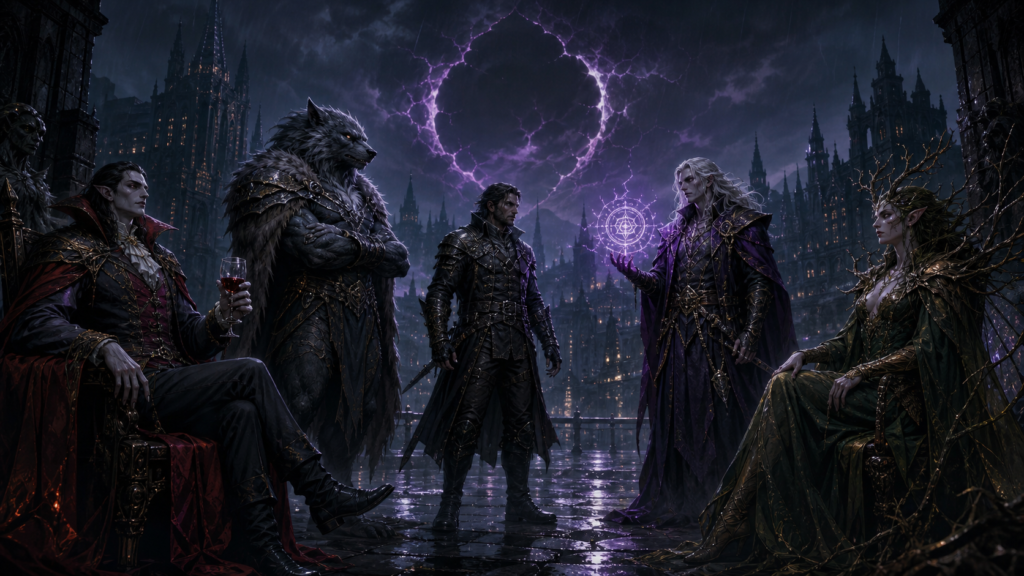
Ebonreach is not ruled by a single crown. Its streets, forests, hidden sanctums, and moonlit courts are divided among supernatural powers with incompatible ideas about survival, freedom, magic, and control. Every alliance carries a price, and every faction remembers who betrayed it.
This guide introduces the five great faction families of Ebonreach: vampire clans, werewolf tribes, hunter creeds, mage covens, and fae courts. Each offers a different way to understand the world—and a different answer to what should happen when the boundary between realities begins to fail.
For an at-a-glance route into every faction page, visit the Ebonreach Factions hub.
Why factions matter in Ebonreach
Factions are more than labels or combat teams. They determine culture, territory, abilities, obligations, enemies, and the kinds of bargains a character is willing to make. Two members of the same supernatural species may still stand on opposite sides of an ancient political divide.
That tension drives both the developing Ebonreach game world and the branching choices of Ebonreach: A Letter from the Dead. Knowing who wants influence, who demands loyalty, and who considers compromise a weakness can mean the difference between gaining an ally and creating a lifelong enemy.
Vampires: immortal politics written in blood
Ebonreach vampires are immortal predators who require blood to survive. Bright light weakens them, while staking the heart, fire, and decapitation remain fatal. Holy symbols offer no automatic protection. What truly defines vampire society, however, is allegiance.
The twelve vampire clans are divided evenly between two competing sects:
- The Crimson Concord believes vampires should rule from the shadows by shaping mortal institutions, alliances, and perceptions.
- The Nocturne Covenant rejects dependence on mortal society and embraces predatory supremacy, mysticism, and separation.
Inside those sects, every clan carries its own culture and supernatural discipline. Clan Vesperin turns etiquette, secrets, and social influence into weapons. By contrast, Clan Ferrum values martial discipline and blood-forged resilience. Clan Archivus feeds upon memory as well as blood, while Clan Umbros walks through living shadow.
A vampire’s clan is sacred. It shapes how they feed, fight, negotiate, remember, and understand immortality. The result is a society where a polite invitation can be more dangerous than an open threat.
Werewolves: Rage-born guardians of land and lineage
The werewolves of Ebonreach are not victims of a simple lunar curse. They are Rage-born shapeshifters descended from primal forces tied to storms, frost, metal, moonlight, fire, and growing things.
Transformation can occur whenever Rage rises through fear, pain, bloodshed, emotional trauma, territorial violation, or tribal rites. A full moon intensifies that Rage and makes the transformed state easier to maintain, but it does not create the transformation. In werewolf form they remain upright, intelligent, powerful, and dangerous—never ordinary wolves.
The six tribes express different relationships with the wild:
- Ashclaw: fire, ash, destruction, and rebirth.
- Frostmane: winter, endurance, and disciplined protection.
- Ironfang: strength, resilience, and an unbreakable pack bond.
- Moonveil: spirit-sight, moonlight, and mystical perception.
- Stormhowl: thunder, speed, freedom, and tempestuous fury.
- Verdantfang: nature, territory, growth, and primal guardianship.
Rage is both gift and danger. It gives werewolves extraordinary force, but uncontrolled overload can fracture judgment and turn instinct against friend as easily as foe.
Hunters: mortal discipline against the supernatural
Hunters are the great mortal counterweight to Ebonreach’s supernatural powers. They possess no innate regeneration and no supernatural bloodline. Their strength comes from preparation, training, specialized weapons, monster lore, and loyalty to a creed.
Four creeds define the methods hunters bring into the dark:
- The Bloodsworn pursue their sworn enemies with relentless, sacrificial resolve.
- The Ironbound rely on heavy armor, formation tactics, and the promise to stand unbroken.
- The Lantern Order protects communities through vigilance, wards, relics, and light.
- The Veilbreakers favor direct assaults, explosives, and uncompromising extermination.
Hunters may cooperate with supernatural beings when necessity demands it, but trust never comes easily. To a hunter, even a useful monster is still a monster—and every magical bargain deserves suspicion.
Mages: inherited power with a cost
Magic in Ebonreach cannot be learned by determination alone. A true mage is born with a mana core and magical resonance, inherited through bloodlines or awakened in rare spontaneous cases. Training is essential: overuse can cause exhaustion, bleeding, hallucinations, collapse, or death.
The four mage covens protect distinct traditions:
- The Astral Chorus channels starfire, gravity, cosmic shields, and astral projection.
- The Thorned Circle draws upon nature spirits, vines, bark wards, and primal transformation.
- The Obsidian Cabal shapes living darkness into bindings, cloaks, mirrors, and shadowed paths.
- The Ember Sigil inscribes fire magic into living runes and sacred tattoos.
Coven discipline provides safety and strength, but it also creates political obligation. Attempting another coven’s tradition can produce catastrophic backlash. Every spell has a cost, and every archive contains knowledge someone believes should remain forbidden.
Fae: primordial courts of emotion and nature
The fae of Ebonreach are not mortals, spirits, or creatures created by the Veil. They are primordial beings tied to emotion, nature, twilight, dreams, and ancient magic. Their identities are defined by four courts:
- The Court of Dawn embodies hope, beginnings, healing, radiance, and renewal.
- The Court of Dusk governs endings, transitions, glamours, illusions, and trickery.
- The Court of Thorns represents primal wilderness, ferocity, growth, and guardianship.
- The Court of Echoes moves through dreams, nightmares, memory, imagination, and the subconscious.
Fae value emotion, symbolism, ritual, and the precise language of bargains. They can be wounded or unravelled, and cold iron disrupts their magic, but their logic is rarely mortal. A fae promise may be perfectly honest and still mean something entirely different from what the listener hoped.
Five powers, one unstable world
No faction exists in isolation. Vampire diplomats bargain with mage archons. Hunters patrol the edges of territories they cannot truly control. Werewolf tribes defend land coveted by courts and covens. Fae rulers remember promises made before mortal institutions existed.
The weakening Veil places every rivalry under greater pressure. Some factions see disaster. Others see liberation, conquest, revelation, or the chance to remake the balance of power. That is the central danger of Ebonreach: even when everyone recognizes the threat, they do not agree on what saving the world should look like.
Where should you explore next?
Begin with the Factions hub to browse every clan, tribe, creed, coven, and court. Then visit the Biomes of Ebonreach to discover the territories these powers protect and contest, or enter the mystery directly through A Letter from the Dead.